St. Petersburg Vodokanal is the second-largest water utility in Russia, providing water supply and sewage services to over 5.6 million residents of the northern capital. The Neva River serves as the primary source of drinking water and also receives treated wastewater.
St. Petersburg was the first megacity to abandon the use of liquid chlorine for water disinfection. The city's nine water treatment plants utilize a biomonitoring system, which involves assessing water quality by analyzing the behavior of live river crayfish and fish that are highly sensitive to even minor water pollutants.
The largest sewage treatment facilities include the Central and Northern Aeration Stations and the Southwestern Treatment Plant, with a total of 21 wastewater treatment stations.
Objective
The Neva River, the city's water source, is characterized by high levels of microbiological contamination: the concentration of harmful microorganisms can exceed permissible norms by hundreds of times. Many of these microorganisms are resistant to chlorination, necessitating an alternative disinfection method.
Solution
Following research and industrial trials, a multi-barrier disinfection scheme was chosen, based on pre-ammonization, chlorination using safe sodium hypochlorite, and UV technology.
The studies revealed that a UV dose of 25 mJ/cm² was sufficient to achieve regulatory concentrations of microbiological indicators and enteroviruses, while a higher dose of 45 mJ/cm² was required to ensure epidemiological safety regarding Clostridium spores. However, even higher UV doses did not result in the formation of disinfection byproducts or changes in water toxicity.
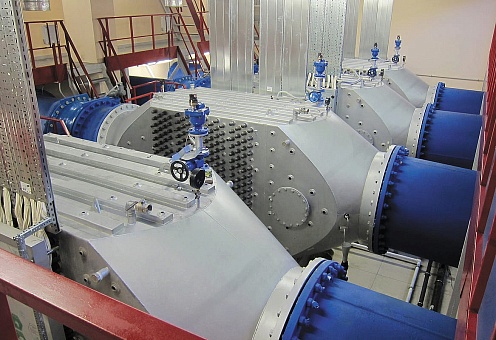
For such large water flows, the most optimal solution was the use of chamber-type UV equipment with crosswise UV lamp placement (VOLTA Group). A custom UV chamber configuration was developed for each water treatment plant to reduce station size.
In 2008, the implementation of the multi-barrier disinfection technology was completed: the UV system complex in St. Petersburg, with a design capacity exceeding 5.5 million m³/day, became the largest in the world at the time of its launch.
Following the transition to the multi-barrier disinfection scheme, the Rospotrebnadzor management for St. Petersburg noted a decrease in hepatitis A incidence from 124 cases per 100,000 people in 2004 to 3.3 cases by 2011.
We use cookies to ensure the website functions properly and to improve your user experience. By clicking "Accept all", you agree to the use of cookies and data processing in accordance with our Privacy Policy.
Accept all
Decline
Customize
Cookie Management
You can customize the cookies you want to allow, except for necessary ones. Disabling some cookies may affect the website’s functionality.
Necessary cookies
You can configure the cookies to suit your preferences, except for the necessary ones. Disabling some cookies may affect the functionality of the website.
Analytical cookies
These cookies allow us to analyze site usage in order to measure and improve its performance.
Functional cookies
These cookies are required to save user settings and preferences.
Marketing cookies
These cookies allow us to tailor advertising offers and make content more relevant to users.